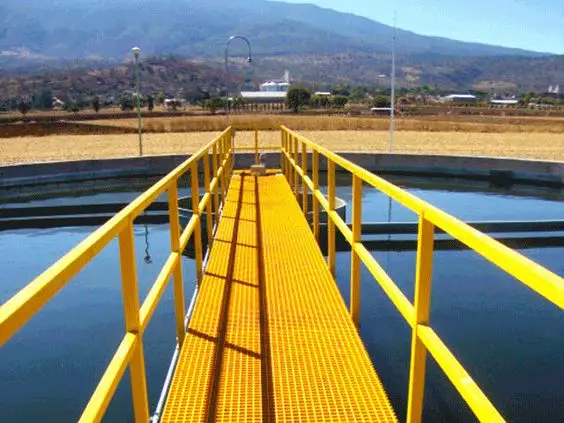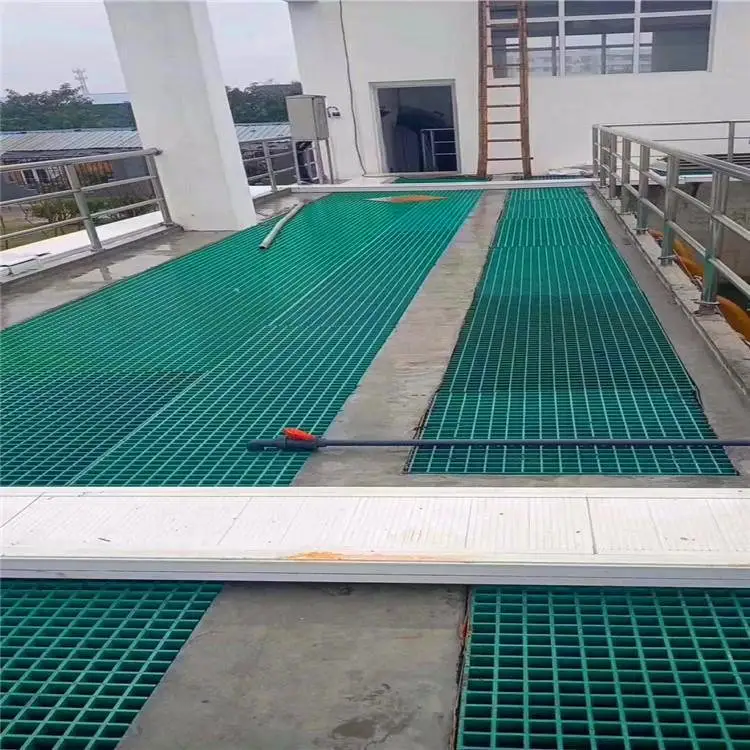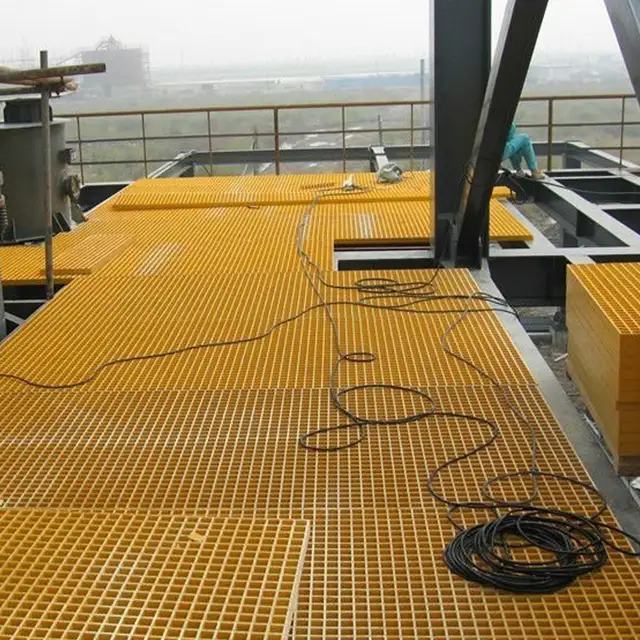
What Is an FRP Platform?
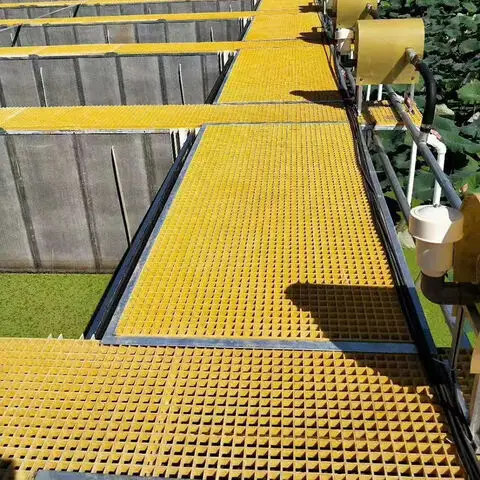
An FRP platform (Fiberglass Reinforced Plastic platform) is a modular structural system built from composite materials — typically a combination of high-strength glass fibers embedded in a thermosetting resin matrix. Unlike traditional metal platforms made of steel or aluminum, FRP platforms are engineered to deliver corrosion resistance, high strength-to-weight ratio, electrical insulation, and decades of maintenance-free service in the harshest industrial environments.
Think of an FRP platform as a complete access system — not just a deck surface. A properly designed FRP platform integrates modular grating panels, structural support beams, guardrails, stair towers, and connection hardware into a unified, pre-engineered solution.
FRP Platform vs Steel vs Aluminum — Head-to-Head Comparison
Engineers and procurement teams evaluating platform materials need objective, side-by-side data. The table below compares FRP, galvanized steel, and aluminum across the metrics that matter most in industrial environments.
| Performance Metric | FRP Platform | Galvanized Steel | Aluminum |
|---|---|---|---|
| Weight | Best ~25 kg/m² |
~90 kg/m² | ~45 kg/m² |
| Corrosion Resistance | Excellent |
Poor |
Moderate |
| Chemical Resistance | Superior |
Poor |
Poor |
| Electrical Conductivity | Non-Conductive |
Conductive |
Conductive |
| Slip Resistance | Excellent |
Moderate |
Moderate |
| Maintenance (20 yr) | None |
High |
Moderate |
| Installation Speed | Fast |
Slow |
Moderate |
| Total Cost of Ownership | Lowest |
Highest |
Moderate |
20-Year TCO Rating
Based on 20-year lifecycle: initial cost + maintenance + replacement in a moderately corrosive industrial environment.
Corrosion Resistance Rating
Acid/alkali/saltwater resistance over continuous exposure. Higher = longer service life without degradation.
Types of FRP Grating for Platforms — Molded vs Pultruded
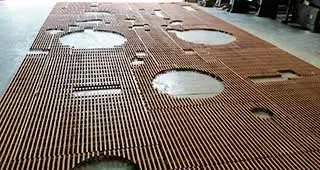
FRP platform decking comes in two primary manufacturing types. Choosing the wrong one can compromise load capacity, chemical resistance, or installation efficiency.
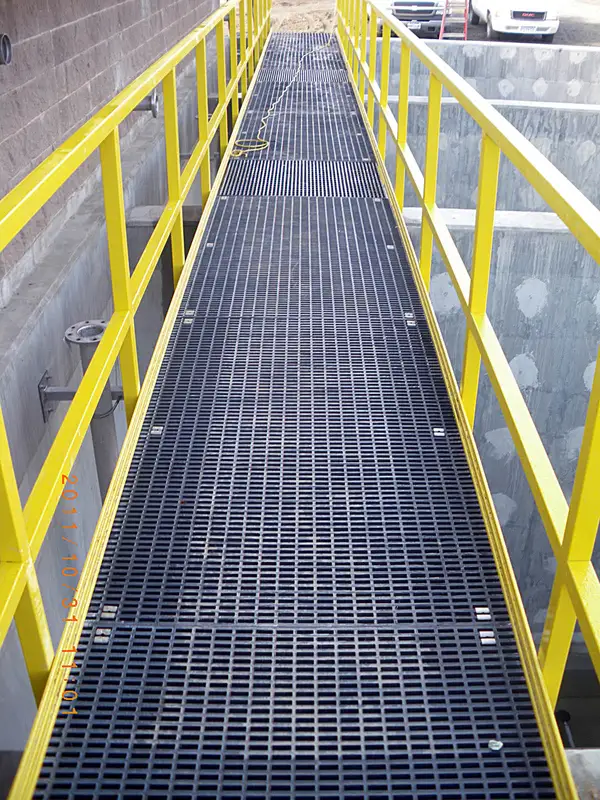
Bi-Directional Molded FRP Grating
Layers of continuous glass fiber strands laid in a mold, saturated with resin under heat and pressure. Forms an integrally bonded grid.
- Mesh pattern: 38×38 mm or 50×50 mm square grid
- Best for: Chemical plants, food processing, water treatment
- Thickness: 25, 30, 38 mm (1", 1.25", 1.5")
- Slip resistance: Integrally molded grit top — permanent
- Max span: Up to 1,200 mm (4 ft)
Uni-Directional Pultruded FRP Grating
Continuous glass fibers pulled through a resin bath and heated die. I-bars or T-bars assembled with cross-rods for high-span strength.
- Bar pattern: Parallel I-bars or T-bars with cross-rods
- Best for: Long spans, heavy loads, offshore, bridges
- Depth: 25 mm to 76 mm (1" to 3")
- Slip resistance: Shop-applied grit coating
- Max span: Up to 2,400 mm (8 ft)
FRP Platform Load Capacity & Span Performance
Load capacity is the #1 specification question from structural engineers. The table below shows typical load ratings under uniform distributed load (UDL), validated against EN 13706 and ASTM D635 testing protocols.
| Grating Type | Thickness | Clear Span | Uniform Load | Point Load | Deflection |
|---|---|---|---|---|---|
| Molded 38×38 mm | 25 mm (1") | 600 mm | 750 kg/m² | 450 kg | < L/100 |
| Molded 38×38 mm | 30 mm (1.25") | 900 mm | 620 kg/m² | 520 kg | < L/100 |
| Molded 38×38 mm | 38 mm (1.5") | 1,200 mm | 500 kg/m² | 680 kg | < L/100 |
| Pultruded I-bar | 38 mm (1.5") | 1,200 mm | 980 kg/m² | 900 kg | < L/200 |
| Pultruded I-bar | 50 mm (2") | 1,800 mm | 750 kg/m² | 1,100 kg | < L/200 |
| Pultruded T-bar HD | 76 mm (3") | 2,400 mm | 600 kg/m² | 1,500 kg | < L/200 |
Resin Selection Guide — Chemical Resistance by Application
The resin system is the single most important specification decision. It determines chemical resistance, fire performance, UV stability, and maximum operating temperature. Selecting the wrong resin can result in premature degradation — even if the fiberglass structure remains intact.
| Resin Type | Best Resistance | Max Temp | Fire Class | Best Applications | Relative Cost |
|---|---|---|---|---|---|
| Isophthalic Polyester | Weak acids, alkalis, water, fuels | 65°C | Class 2 | Water treatment, cooling towers, general industrial | $ Base |
| Vinyl Ester | Strong acids, caustics, bleach, solvents | 100°C | Class 1 | Chemical plants, plating shops, pickling lines | $$ +50% |
| Phenolic | Best fire/smoke/toxicity | 150°C | Class 1 | Offshore platforms, tunnels, rail transit | $$$ +100% |
| Fire-Retardant Iso | Standard chemical + enhanced fire | 65°C | Class 1 | Food processing, pharmaceutical, indoor | $$ +30% |
| UV-Stabilized Polyester | Standard + outdoor weathering | 65°C | Class 2 | Rooftop solar, outdoor platforms, marine decks | $$ +25% |
Industry Standards & Certifications for FRP Platforms
FRP platforms in regulated industries must comply with specific standards. Here are the key certifications required by procurement and engineering teams worldwide:
ASTM E84
Surface burning characteristics. FRP with fire-retardant resin achieves Class 1 (Flame Spread ≤ 25). Required for indoor industrial and offshore.
EN 13706
European standard for pultruded structural profiles. Defines material grades E23 / E17 and mechanical property testing protocols.
ISO 9001:2015
Quality management certification. Full traceability from raw material lot to finished product. Material test certificates with every shipment.
BS 476 Part 7
UK standard for surface spread of flame. Required for Commonwealth construction, rail infrastructure, offshore installations.
OSHA 1910.23
Walking-working surfaces: guardrail height 42", mid-rail 21", toeboard 4", load ≥ 4× intended. Full compliance out of the box.
ASTM D635
Horizontal burn rate test. Confirms FRP material self-extinguishing behavior — critical for fire safety compliance in all industries.
FRP Platform Applications Across Industries
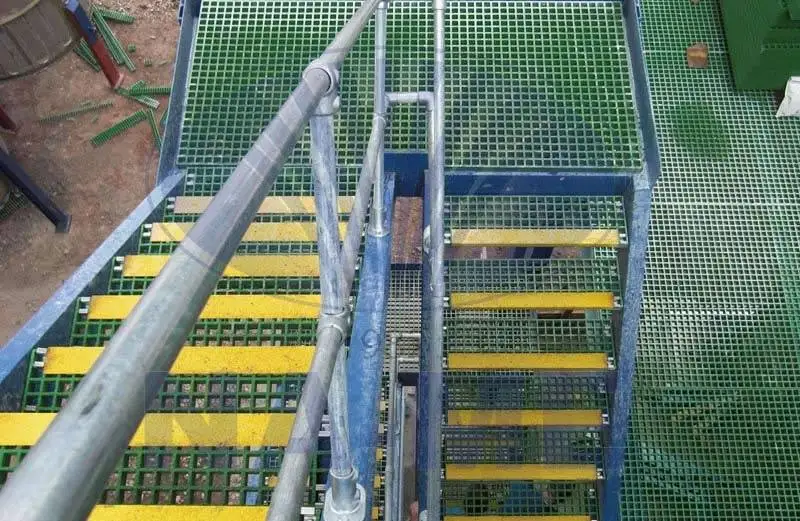
FRP platforms solve unique challenges in every industry. Here is how they perform across the most demanding applications:
Offshore Oil & Gas
Saltwater spray, UV exposure, fire safety (ASTM E84 Class 1 required). Zero corrosion, 75% lighter than steel, non-sparking for explosive atmospheres. Phenolic resin for stringent offshore fire codes.
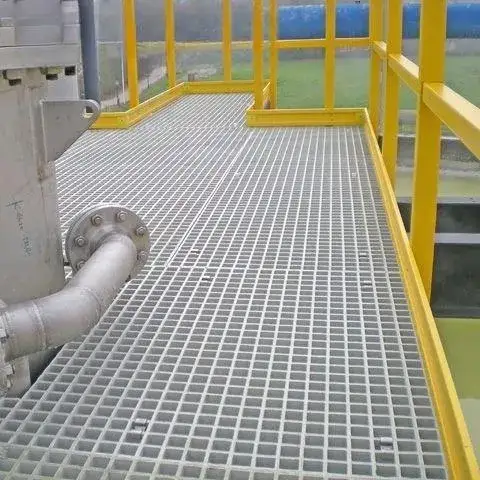
Chemical Processing
Daily exposure to acids, caustics, solvents. Vinyl ester resin handles HCl, H₂SO₄, NaOH, sodium hypochlorite. Galvanized steel fails in 2-5 years here. See our chemical plant walkway page.
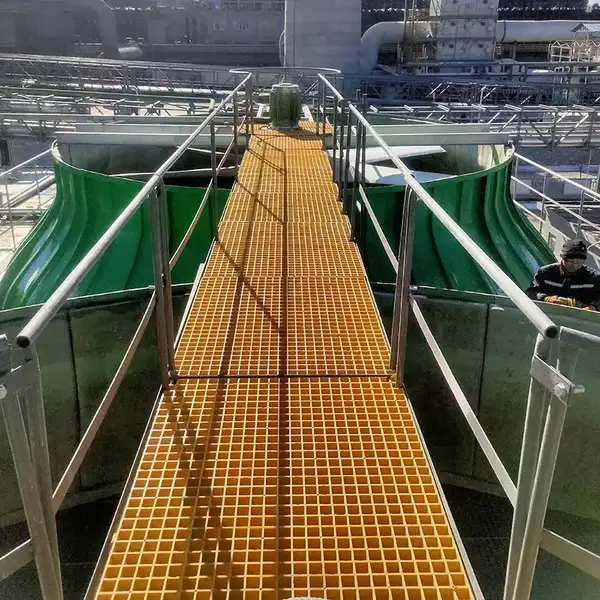
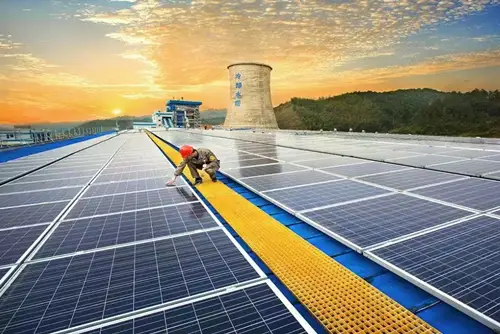
Rooftop Solar Access
75% lighter than steel — critical for roof load limits. UV-stabilized resin for 20+ years outdoors. Non-penetrating designs protect roof membrane. See our FRP solar walkway guide.
Food & Beverage + More
Also suited for: water/wastewater treatment (chlorine-resistant), power generation (non-conductive), rail transit platforms (overnight installation), and general manufacturing. Non-porous, easy to sanitize — FDA/USDA compliant materials available.
FRP Platform Installation — Step-by-Step Guide
Installing an FRP platform is significantly faster and safer than steel — no welding, no hot work permits, and panels light enough for two-person handling.
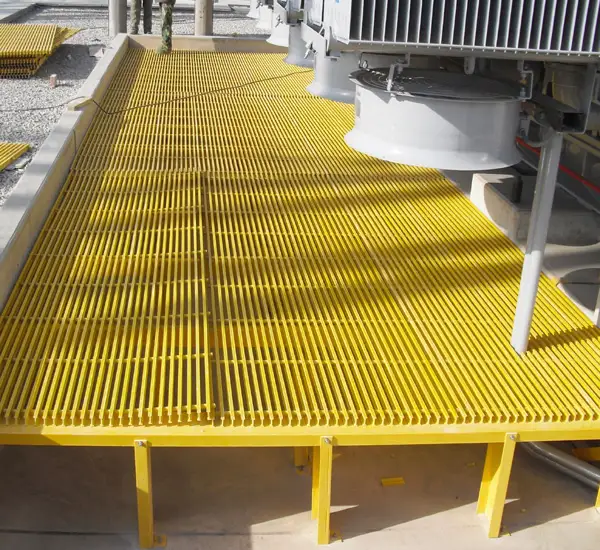
-
1. Site Preparation & Layout
Verify support steel dimensions. Mark centerlines and grid positions. Ensure surfaces are level within ±3 mm. Clean debris from support beams.
-
2. Install Support Framing
Bolt FRP structural shapes to primary steel using 316 stainless fasteners. Never weld FRP to steel — use bolted connections. Torque all fasteners to specification.
-
3. Position Grating Panels
Place panels grit-side UP. Minimum 38 mm (1.5") bearing on each support. Leave 6 mm (1/4") gap between panels for thermal expansion.
-
4. Cut & Seal Panels
Use diamond-grit or carbide-tipped blade. Wear NIOSH-approved respirator — FRP cutting generates fiberglass dust. Seal cut edges with resin coating within 24 hrs. Apply two coats minimum.
-
5. Fasten Panels to Supports
Use 316 SS M-clips or saddle clips at every support intersection. Torque to 8-12 N·m (M8 fasteners). Do not overtighten — FRP crushes under excessive point loading.
-
6. Install Guardrails & Toeboards
Bolt guardrail posts to platform base plates. Top rail at 1,067 mm (42"), mid-rail at 533 mm (21"), toeboard 100 mm (4") — per OSHA 1910.23.
-
7. Final Inspection & Load Test
Visual inspection of all fasteners and cut edges. Walk-through for stability. For critical installations: proof load test at 125% design load. Document results.
How Much Does an FRP Platform Cost?
FRP platform pricing depends on four primary factors: grating type (molded vs pultruded), resin system, panel thickness, and order quantity. The table below provides factory-direct pricing ranges for planning purposes.
| Configuration | Type | Resin | Thickness | FOB/m² | MOQ | Tier |
|---|---|---|---|---|---|---|
| Standard walkway | Molded 38×38 | Isophthalic | 30 mm | $35–55 | 50 m² | Economy |
| Chemical plant | Molded 38×38 | Vinyl Ester | 38 mm | $55–85 | 50 m² | Mid-Range |
| Heavy industrial | Pultruded I-bar | Isophthalic | 50 mm | $65–95 | 30 m² | Mid-Range |
| Offshore fire-rated | Pultruded T-bar | Phenolic | 50 mm | $120–180 | 50 m² | Premium |
| Solar rooftop | Molded micro | UV-stabilized | 25 mm | $30–45 | 30 m² | Economy |
What Drives FRP Platform Cost?
- 1 Resin type — Vinyl ester / Phenolic cost 2-3× more than standard polyester
- 2 Panel thickness — Each 6 mm increase adds ~15-20% material cost
- 3 Order volume — MOQ 50 m²; significant discounts at 200+ m²
- 4 Custom fabrication — Pre-cut panels, odd sizes, special colors add 10-25%
Factory-Direct Advantage
As a manufacturer with 23+ years of FRP production experience serving 45+ countries, Dengtai offers factory-direct pricing typically 20-35% below distributor markup. No middleman. Full traceability from raw resin to finished panel — ISO 9001 certified since 2011.
For a detailed breakdown: FRP Walkway Platform Cost Guide →
Fire Resistance & Safety Features
For industries with stringent fire safety requirements — offshore oil and gas, tunnels, rail transit, indoor manufacturing — FRP platforms can be manufactured with fire-retardant resin systems that meet or exceed regulatory standards.
Additional safety features inherent to ALL FRP platforms: electrical non-conductivity (no grounding required), non-sparking surface (explosive atmospheres), integrally molded anti-slip grit (CoF ≥ 0.8 wet or dry).
How Long Do FRP Platforms Last? — Lifecycle & Maintenance
FRP platforms have a design service life of 25-30+ years in most industrial environments — significantly longer than galvanized steel (10-15 years) and aluminum (15-20 years).
| Material | Typical Lifespan | Maintenance / Year | Replacement Cycles (30 yr) | 30-Year Cost Index |
|---|---|---|---|---|
| FRP Platform | 25-30 yr | $0 (visual inspection only) | 0 | 1.0× |
| Aluminum | 15-20 yr | Oxidation treatment | 1 | 2.3× |
| Galvanized Steel | 10-15 yr | Recoating + rust repair | 2-3 | 3.5× |
Frequently Asked Questions
Standard FRP grating is designed for pedestrian traffic and light carts (UDL up to 750 kg/m²). Forklift or vehicle traffic requires a custom heavy-duty pultruded design with closer support spacing. Contact our engineering team — never assume a standard walkway panel can support vehicle loads.
FRP costs 1.3-1.8× more upfront. Over 20 years, FRP is 40-60% cheaper after accounting for 2-3 steel recoating cycles, rust repair, and replacement. In corrosive environments, steel may need replacement in 5-10 years — making FRP 3-5× cheaper over the full lifecycle.
No. Integrally molded grit surface provides CoF ≥ 0.8 wet and dry — exceeding OSHA recommendations. Open mesh allows liquids to drain through, eliminating standing water that causes slips on checker plate or smooth surfaces.
Yes — if specified with UV-stabilized resin. Standard polyester will chalk cosmetically under UV (not structural). UV inhibitors prevent yellowing. The fiberglass structure itself is unaffected by sunlight — full strength retained after decades outdoors.
Minimum: ISO 9001 (quality management), material test certificates per batch, ASTM E84 fire reports. Offshore/marine: IMO FTP Code. European projects: EN 13706 material grade certification. Reputable manufacturers provide full traceability from raw resin lot to finished panel serial number.
Standard panels (up to 1,220 × 3,660 mm) ship palletized via ocean freight or truck. Lead time: 15-25 days for molded grating, 20-35 days for pultruded. Custom resin or fire-rated panels: add 5-10 days. Rush orders accommodated — contact our logistics team for priority scheduling.
Get a Factory-Direct Quote for Your FRP Platform Project
With 23+ years of FRP manufacturing experience, 3,200+ projects delivered across 45+ countries, and ISO 9001 certified production since 2011, Dengtai is your trusted partner for industrial FRP platform solutions.
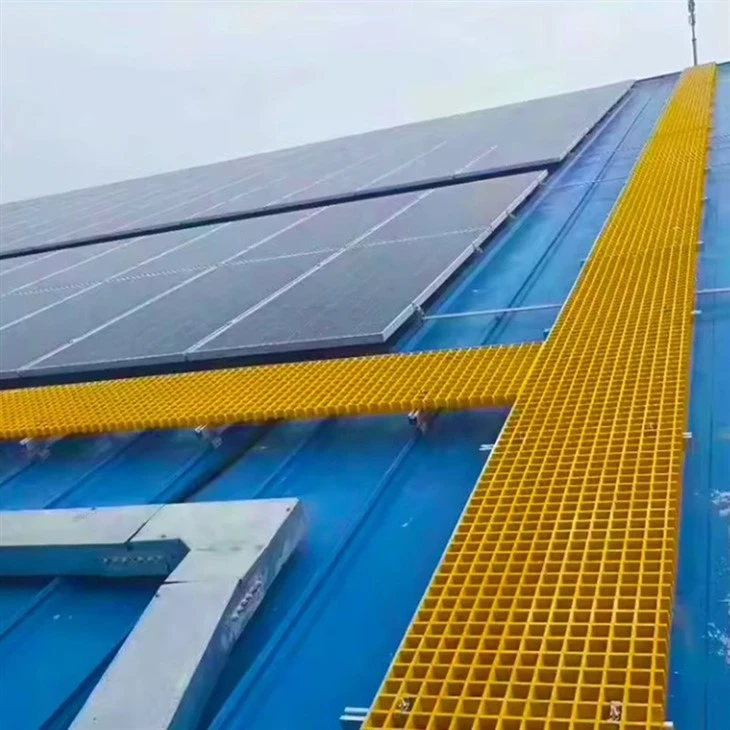
Request Your FRP Platform Quote →
Our engineering team provides specifications, load calculations, and factory-direct pricing within 48 hours.